Types of Trellis: Which Trellis Works Best for Which Plant
Choosing the right trellis can make the difference between a thriving vertical garden and a tangled, unmanageable mess. Not every trellis works for every plant. A cucumber needs something different from a rose. A bottle gourd needs a completely different structure than a sweet pea.
This guide breaks down every major type of trellis, what it is best suited for, how to set it up, and exactly which plants will perform best on each one — so you can make the right choice for your garden from the very beginning.
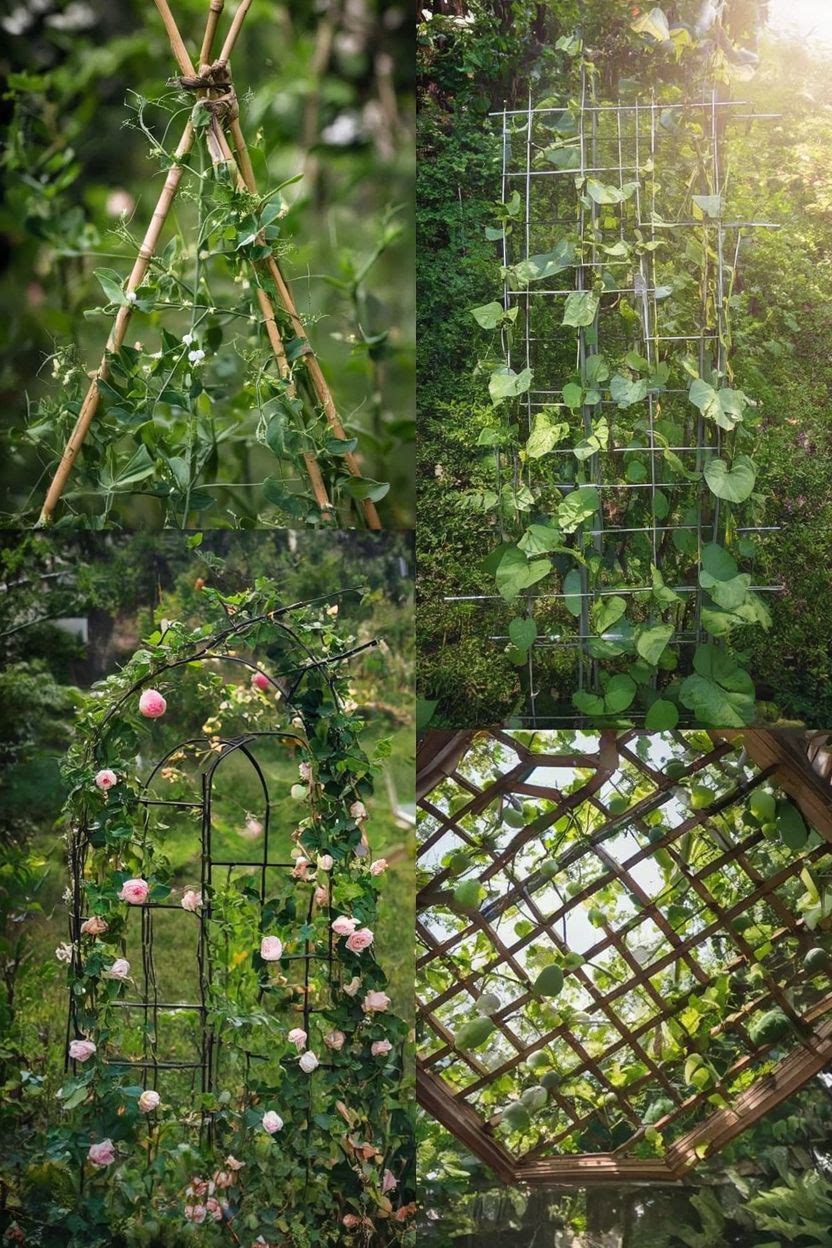
1. A-Frame Trellis
An A-frame trellis is shaped like the letter A — two panels leaning against each other and joined at the top. Plants grow up both sides, and the structure stands independently without any wall or fence support.
This is one of the most versatile trellis designs because it can be placed anywhere in the garden, moved easily, and used for a wide variety of plants.
How to set it up: Build or buy two rectangular wooden or bamboo frames. Cover each with wire mesh or string netting. Join them at the top with a hinge or rope. Open the base to the desired width and push the legs into the soil for stability.
Best plants for A-frame trellis:
- Cucumbers
- Pole beans and runner beans
- Peas
- Small gourds
- Sweet peas (flowering)
- Nasturtium
Why it works: The two-sided design doubles your growing surface in the same footprint. You can plant on both sides and harvest from either direction. The triangular shape also creates a shaded area underneath that is perfect for growing lettuce, spinach, or coriander in summer.
Estimated cost: ₹800 – ₹2,500
2. Flat Panel Trellis (Wall Trellis)
A flat panel trellis is a single upright structure fixed to a wall, fence, or freestanding frame. It can be made from wood, bamboo, metal, or plastic and comes in grid, diamond, or square patterns.
This is the most common trellis type used in home gardens because it is simple, affordable, and fits neatly against any vertical surface.
How to set it up: Fix wall anchors into the wall at regular intervals. Attach horizontal wires or a pre-made trellis panel. Leave a gap of at least 10 cm between the wall and the trellis so air can circulate behind the plant.
Best plants for flat panel trellis:
- Tomatoes
- Chillies (tall varieties)
- Jasmine
- Bougainvillea
- Madhumalti (Rangoon Creeper)
- Roses (climbing varieties)
- Money plant
- Ivy
Why it works: A flat panel trellis is ideal for plants that need a permanent, stable structure. It is especially good for flowering climbers that you want to display against a wall or fence as a living decoration.
Estimated cost: ₹500 – ₹2,000
3. Bamboo Tepee Trellis
A bamboo tepee is formed by pushing 4 to 8 bamboo poles into the ground in a circle and tying them together at the top. The result is a cone-shaped frame that plants climb up from the base.
This is one of the most affordable, easy to build, and visually charming trellis options available. It is a favourite among beginner gardeners because it requires no tools and can be assembled in minutes.
How to set it up: Push 6 bamboo poles into the soil in a circle about 60 cm in diameter. Gather all poles at the top and tie firmly with garden twine. Optionally, wind additional twine horizontally around the poles at 20 cm intervals to give climbing plants more grip.
Best plants for bamboo tepee:
- Pole beans
- Runner beans
- Peas
- Morning glory
- Thunbergia
- Small cucumbers
Why it works: The tepee shape is naturally strong because the poles support each other. Plants trained up a tepee create a beautiful green cone shape that looks decorative even in a small garden or on a terrace. Multiple tepees arranged in a row create a striking visual feature.
Estimated cost: ₹200 – ₹600
4. Overhead Pandal Trellis
A pandal trellis is an overhead horizontal structure — like a flat roof of wire mesh or rope netting supported on four or more vertical posts. Plants grow up the posts and then spread horizontally across the top, with fruits hanging down underneath.
This is the traditional Indian method for growing heavy gourds and is the most productive trellis system for tropical climbing vegetables.
How to set it up: Install four or more vertical posts at the corners of your growing area at a height of 180 to 220 cm. Connect horizontal pipes or bamboo poles across the top. Stretch heavy-gauge wire mesh or strong rope netting across the top frame. Secure firmly at all points to handle the weight of mature fruits.
Best plants for overhead pandal trellis:
- Bitter gourd (karela)
- Bottle gourd (lauki)
- Ridge gourd (turai)
- Snake gourd
- Pointed gourd (parwal)
- Pumpkin
- Watermelon (with fruit support nets)
Why it works: Gourds and heavy climbing vegetables need strong horizontal support that allows fruits to hang freely. A pandal provides this perfectly while also creating a shaded space underneath that can be used for shade-tolerant plants. It is the highest-yielding trellis setup for tropical kitchen gardens.
Estimated cost: ₹2,000 – ₹6,000 depending on size and materials
5. Wire Trellis (Two-Wire or Multi-Wire)
A wire trellis uses horizontal wires stretched between upright posts at different heights. This is the standard trellis used in commercial fruit and berry growing and is highly effective for home gardens too.
It is durable, low-profile, and allows plants to be trained very precisely at specific heights.
How to set it up: Install sturdy posts at each end of your growing row. Attach wire tensioners or eyelet screws at 40 to 50 cm intervals up each post. Run galvanised wire through the eyelets and pull taut with a tensioner or by wrapping tightly. Add a middle post for rows longer than 3 metres.
Best plants for wire trellis:
- Raspberries
- Blackberries
- Tomatoes (indeterminate)
- Grapes
- Kiwi
- Espalier fruit trees (apple, pear)
- Passion fruit
Why it works: Wire trellises are strong enough to support heavy fruit-laden canes and branches. The multi-wire design allows you to train different growth stages at different heights — new growth on upper wires and fruiting canes on lower wires. This separation makes pruning and harvesting much simpler.
Estimated cost: ₹800 – ₹3,000 per 3-metre row
6. Cattle Panel or Wire Mesh Panel Trellis
A cattle panel is a large rectangular welded wire panel originally used for livestock fencing. Gardeners have adopted it as a heavy-duty trellis that requires no building — just stake it upright and plant at the base.
The rigid grid structure means plants grow through the mesh naturally with minimal tying required.
How to set it up: Push two or more metal stakes into the ground at your planting location. Wire the cattle panel to the stakes securely. The panel stands upright on its own once staked. Plant at the base and allow plants to weave through the mesh as they grow.
Best plants for cattle panel trellis:
- Thornless blackberries
- Cucumbers
- Squash and small pumpkins
- Beans
- Peas
- Climbing roses
Why it works: The rigid structure handles heavy plants and vigorous climbers without sagging. Unlike string or netting trellises, a cattle panel lasts for many years with zero maintenance. It is especially good for plants with thick stems that need a firm grid to grip rather than thin string.
Estimated cost: ₹1,500 – ₹4,000 per panel
7. Fan Trellis
A fan trellis spreads outward from a narrow base in a fan or semicircle shape. It is typically wall-mounted and used to train plants in an expanding fan pattern radiating from a central point near the ground.
This trellis creates a beautiful formal garden look and is widely used for fruit trees trained as espaliers and for ornamental flowering climbers.
How to set it up: Fix a central anchor point low on the wall. Run wires outward and upward from this point in a fan shape, securing each wire to the wall at the outer edge. Alternatively, use a pre-made wooden or metal fan trellis panel fixed directly to the wall.
Best plants for fan trellis:
- Peach and nectarine (fan-trained)
- Fig
- Gooseberry
- Redcurrant
- Climbing roses
- Jasmine
- Clematis
Why it works: The fan pattern spreads branches and canes evenly across a wall surface, giving every part of the plant equal sunlight exposure. This is the preferred method for training fruit trees against a warm, sunny wall to extend the growing season in cooler climates.
Estimated cost: ₹600 – ₹2,500
8. Arch or Tunnel Trellis
An arch trellis is a curved structure that creates a garden archway or tunnel. Plants grow up both sides and eventually meet at the top, creating a dramatic canopy of leaves, flowers, or hanging fruits.
A single arch serves as a garden entrance feature. Multiple arches in a line create a tunnel that you can walk through — one of the most impressive features in any garden.
How to set it up: Bend metal rebar, PVC pipe, or use pre-made arch frames into a curved shape. Push both ends firmly into the ground. Cover with wire mesh or string netting for climbing plants to grip. For a tunnel, repeat arches at 60 to 90 cm intervals and connect them along the top with horizontal wire.
Best plants for arch trellis:
- Roses (climbing varieties)
- Bougainvillea
- Passion fruit
- Cucumbers (single arch)
- Beans (tunnel)
- Wisteria
- Morning glory
- Madhumalti
Why it works: An arch trellis is as much a garden design feature as it is a functional plant support. It creates vertical drama and a sense of entry or passage in the garden. Flowering climbers like roses and bougainvillea are especially spectacular when trained over an arch in full bloom.
Estimated cost: ₹1,500 – ₹8,000 depending on size and material
9. Cage Trellis
A cage trellis surrounds a single plant with a cylindrical wire frame. The plant grows upward inside and through the cage, supported on all sides without any tying required.
This is the simplest trellis for large bushy plants that need all-round support rather than directional training.
How to set it up: Push a cylindrical wire cage into the soil around the base of the plant at planting time. As the plant grows, guide main stems through the cage openings. No tying is necessary — the cage holds the plant from all sides.
Best plants for cage trellis:
- Tomatoes (determinate and indeterminate)
- Chillies (large varieties)
- Eggplant / Brinjal
- Peppers
- Small squash
Why it works: A cage trellis requires almost no maintenance. You do not need to tie, train, or adjust the plant regularly. It is the best low-effort support system for productive fruiting vegetables that grow in all directions rather than in a single upright stem.
Estimated cost: ₹300 – ₹1,200
10. String or Netting Trellis
A string or netting trellis uses horizontal and vertical strings — or pre-made nylon or jute netting — stretched between two posts or fixed points. It is the lightest and most affordable trellis option.
String trellises are ideal for lightweight climbers and annual vegetables that only need support for one season.
How to set it up: Fix two posts or hooks at either end of your growing area. Stretch netting tightly between them and secure at the top and bottom. For a DIY string trellis, tie horizontal strings at 15 to 20 cm intervals between the posts and vertical strings crossing them to form a grid.
Best plants for string or netting trellis:
- Peas
- Cucumbers (light varieties)
- Beans
- Morning glory
- Sweet peas
- Thunbergia
- Small melons (with fruit support pouches)
Why it works: String and netting trellises are perfect for seasonal gardens because they are easy to put up and take down at the end of the growing season. Jute netting can be composted after use, making it a zero-waste option for eco-conscious gardeners.
Estimated cost: ₹200 – ₹800
11. Quick Reference Chart: Trellis Type by Plant
| Plant | Best Trellis Type | Strength Needed |
|---|---|---|
| Cucumber | A-frame, String netting, Bamboo tepee | Medium |
| Pole Beans | Bamboo tepee, A-frame, String | Light to Medium |
| Tomatoes | Wire trellis, Cage, Flat panel | Medium |
| Bitter Gourd | Overhead pandal | Heavy |
| Bottle Gourd | Overhead pandal | Very Heavy |
| Ridge Gourd | Overhead pandal | Heavy |
| Peas | String netting, Bamboo tepee | Light |
| Raspberries | Wire trellis (two-wire) | Medium |
| Blackberries | Wire trellis, Cattle panel | Heavy |
| Grapes | Wire trellis, Pergola | Very Heavy |
| Passion Fruit | Arch, Wire trellis, Overhead | Heavy |
| Roses (climbing) | Arch, Flat panel, Fan | Medium |
| Bougainvillea | Arch, Flat panel | Heavy |
| Jasmine | Flat panel, Fan, Bamboo frame | Light |
| Morning Glory | String, A-frame, Bamboo tepee | Light |
| Money Plant | Flat panel, Wall wire | Light |
12. How to Choose the Right Trellis for Your Garden
Ask yourself these four questions before buying or building a trellis.
How heavy will the plant get? Gourds and grapes need very strong structures. Peas and morning glory need only light support. Match the strength of your trellis to the mature weight of your plant.
How much space do I have? A bamboo tepee works in a single container. An overhead pandal needs open terrace space. Choose a trellis that fits your available area.
Is this a permanent or seasonal setup? For seasonal vegetables, use bamboo, string, or netting that can be removed easily. For permanent fruit plants, invest in wire, metal, or treated timber that will last many years.
Do I want it to look decorative? Arch and fan trellises add beauty to the garden. Wire and cage trellises are purely functional. Choose based on whether aesthetics matter for your space.
Final Thoughts
The right trellis is one of the most important decisions you make for a vertical garden. It determines how well your plants grow, how easy they are to manage, and how productive your garden becomes over time.
Start with a simple bamboo tepee or string netting for seasonal vegetables. As your garden grows, invest in a strong wire trellis for berries or an overhead pandal for gourds. Each trellis you add opens up new possibilities for what you can grow and how beautifully your garden can look.
Match the trellis to the plant — and let your garden grow upward. 🌿