Top 10 Farming Land Countries in the World & Their Key Farm Trees
The world’s agricultural landscapes are shaped by the trees that grow in them — from fruit orchards to rubber plantations.
Agriculture feeds the world — but behind every grain field and vegetable patch, there are trees doing equally important work: providing fruit, oil, rubber, spice, timber, and medicine. In this deep-dive guide, we explore the top 10 countries by agricultural farmland, focusing specifically on the key trees grown commercially in each country, along with their close botanical relatives.
Whether you are a farmer, a horticulture student, an agri-entrepreneur, or simply curious about where your food comes from — this guide is for you.
Why Trees Matter in Agriculture
Trees are the backbone of agroforestry, orchard farming, plantation agriculture, and permaculture. Unlike annual crops (wheat, corn, rice), trees:
- Produce yields for decades after planting
- Build soil health through leaf litter and root systems
- Provide shade and windbreaks for other crops
- Sequester carbon while generating income
- Often yield multiple products (fruit + timber + medicine)
Now let’s travel the globe and meet the top farming nations — and their trees.
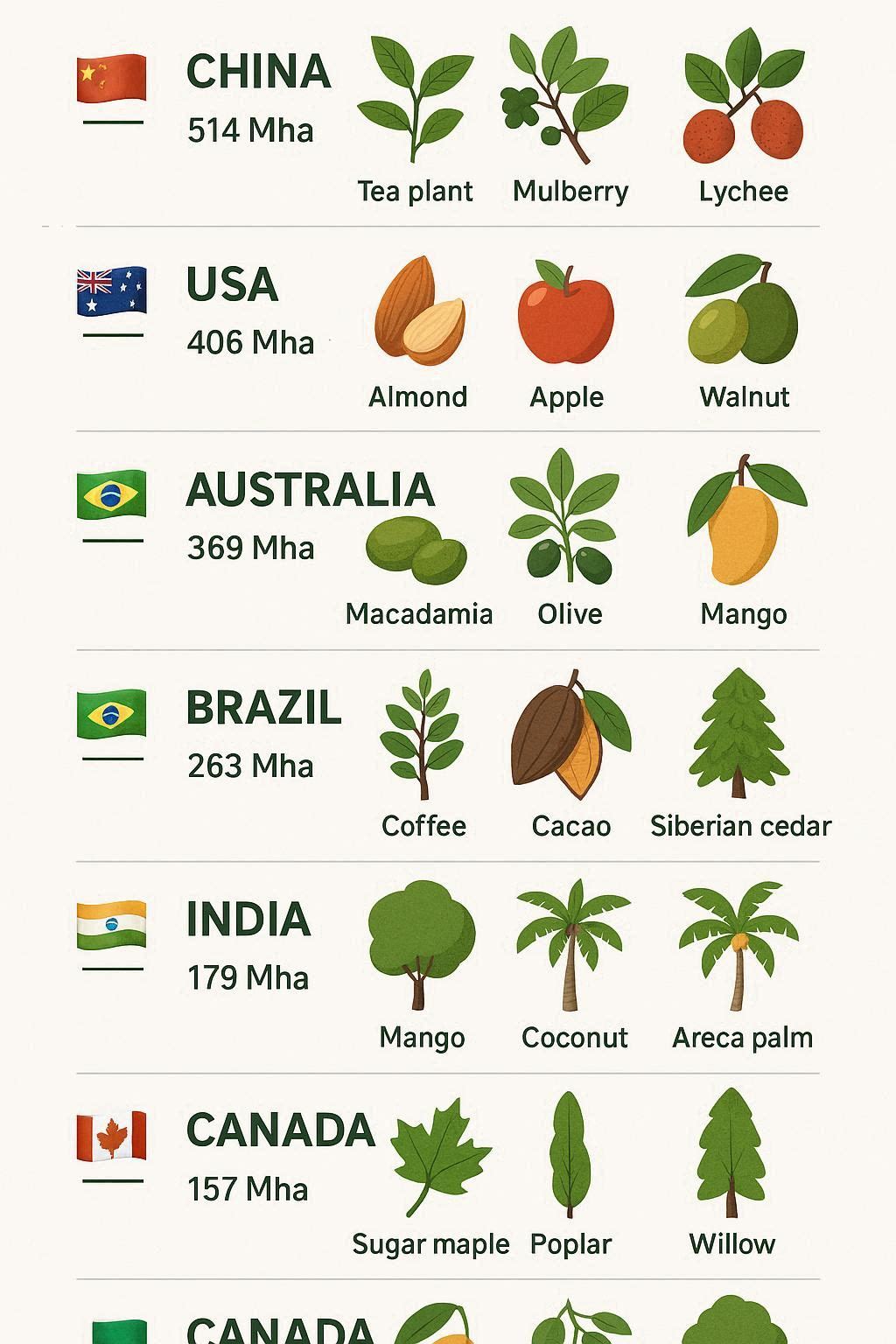
🌏 1. China — ~5.1 Million km² of Agricultural Land
China’s terraced tea plantations are among the most iconic agricultural landscapes on Earth.
China holds the largest agricultural land area in the world and is the world’s number one producer of dozens of crops. Its tree farming ranges from ancient tea gardens in Yunnan to modern lychee orchards in Guangdong.
Key Farm Trees in China
| Tree | Scientific Name | Primary Use |
|---|---|---|
| Tea Plant | Camellia sinensis | Green, black & white tea |
| Mulberry | Morus alba | Silkworm feed (sericulture) |
| Lychee | Litchi chinensis | Tropical fruit export |
| Chinese Jujube | Ziziphus jujuba | Fruit & traditional medicine |
| Longan | Dimocarpus longan | Fresh & dried fruit |
| Tung Oil Tree | Vernicia fordii | Industrial & marine coatings oil |
Related Trees (Botanical Relatives)
- Tea Plant → Camellia japonica, Camellia taliensis
- Mulberry → Morus nigra (black mulberry), Morus rubra (red mulberry)
- Lychee → Dimocarpus longan (longan), Euphoria longan
- Jujube → Ziziphus mauritiana, Ziziphus spina-christi
Farmer’s Tip: China’s Morus alba (white mulberry) is also gaining global traction as a superfood — its leaves are rich in antioxidants and increasingly used in health supplements.
🌎 2. United States — ~4.1 Million km² of Agricultural Land
California’s almond orchards produce about 80% of the world’s almonds.
The US is the world’s dominant agricultural powerhouse — corn, soybeans, wheat — but its tree crop sector is equally formidable, particularly in California, Florida, and the Pacific Northwest.
Key Farm Trees in the United States
| Tree | Scientific Name | Primary Use |
|---|---|---|
| Apple | Malus domestica | Fresh fruit, cider, juice |
| Peach | Prunus persica | Stone fruit markets |
| Navel Orange | Citrus sinensis | Fresh juice & export |
| Almond | Prunus dulcis | Nut export (California dominates globally) |
| Walnut | Juglans regia | Nut production |
| Avocado | Persea americana | Fresh market & guacamole |
Related Trees (Botanical Relatives)
- Apple → Pyrus communis (pear), Malus sylvestris (crab apple)
- Almond → Prunus amygdalus, Prunus communis
- Walnut → Juglans nigra (black walnut), Juglans californica
- Avocado → Persea drymifolia (Mexican avocado leaf), Persea schiedeana
Did You Know? The US grows over 1 million acres of almond trees in California’s Central Valley — and they are entirely dependent on honeybee pollination, making bees a critical agricultural “input.”
🌏 3. Australia — ~3.7 Million km² of Agricultural Land
Australia is the birthplace of the macadamia nut — now one of the world’s premium farm nuts.
Australia’s vast farmlands stretch from the tropical north (Queensland mangoes) to the temperate south (Victorian apples). Its native tree crops are gaining global recognition.
Key Farm Trees in Australia
| Tree | Scientific Name | Primary Use |
|---|---|---|
| Macadamia | Macadamia integrifolia | Premium native nut |
| Olive | Olea europaea | Oil & table olives |
| Mango | Mangifera indica | Tropical export fruit |
| Avocado | Persea americana | Subtropical fresh market |
| Mandarin | Citrus reticulata | Fresh fruit & juice |
Related Trees (Botanical Relatives)
- Macadamia → Macadamia tetraphylla, Grevillea banksii
- Olive → Olea africana, Olea capensis
- Mango → Mangifera odorata, Mangifera foetida
Agroforestry Note: Australia is actively expanding its olive belt in South Australia and Western Australia, with some farms producing award-winning extra virgin olive oils that rival Mediterranean producers.
🌎 4. Brazil — ~2.4 Million km² of Agricultural Land
Brazil is responsible for approximately one-third of the world’s total coffee production.
Brazil is a biological treasure chest — home to the Amazon, the world’s greatest biodiversity, and some of the planet’s most important commercial tree crops.
Key Farm Trees in Brazil
| Tree | Scientific Name | Primary Use |
|---|---|---|
| Arabica Coffee | Coffea arabica | World’s leading coffee export |
| Cacao | Theobroma cacao | Chocolate & cocoa butter |
| Rubber Tree | Hevea brasiliensis | Natural rubber (origin country) |
| Brazil Nut | Bertholletia excelsa | Premium nut export |
| Cupuaçu | Theobroma grandiflorum | Fruit, cosmetics, “white chocolate” |
| Açaí Palm | Euterpe oleracea | Global superfruit export |
Related Trees (Botanical Relatives)
- Coffee → Coffea canephora (Robusta), Coffea liberica
- Cacao → Theobroma grandiflorum (cupuaçu), Herrania purpurea
- Rubber → Hevea guianensis, Hevea benthamiana
- Brazil Nut → Lecythis pisonis, Couratari guianensis
Sustainability Spotlight: Brazil nut trees (Bertholletia excelsa) can only be grown and harvested in intact rainforest — making them a powerful economic incentive for forest conservation. A thriving Brazil nut industry literally pays to protect the Amazon.
🌍 5. Russia — ~2.2 Million km² of Agricultural Land
Russia’s heritage apple varieties, like Antonovka, have been cultivated for centuries.
Russia’s agricultural might is mostly grains — but its orchard and wild-harvest tree crop sector is substantial, particularly in the Volga region, Krasnodar, and Siberia.
Key Farm Trees in Russia
| Tree | Scientific Name | Primary Use |
|---|---|---|
| Apple (Antonovka) | Malus domestica cv. | Heritage orchard variety |
| Siberian Cedar Pine | Pinus sibirica | Pine nut production |
| Sea Buckthorn | Hippophae rhamnoides | Medicinal berry & oil |
| Hawthorn | Crataegus monogyna | Medicinal & hedgerow fruit |
Related Trees (Botanical Relatives)
- Cedar Pine → Pinus koraiensis (Korean pine nut), Pinus pumila
- Sea Buckthorn → Hippophae salicifolia, Elaeagnus rhamnoides
- Hawthorn → Crataegus laevigata, Crataegus oxyacantha
Health Food Trend: Hippophae rhamnoides (sea buckthorn) berries contain one of the highest concentrations of Vitamin C in the plant kingdom — up to 15x more than oranges — and are now exported from Siberia to health food markets worldwide.
🌏 6. India — ~1.8 Million km² of Agricultural Land
India is the world’s largest producer of mangoes, accounting for nearly 45% of global output.
India’s diversity of climates — from the Himalayan foothills to Kerala’s tropics — supports an extraordinary variety of farmed trees. India is also the spiritual homeland of many of the world’s most important tree crops.
Key Farm Trees in India
| Tree | Scientific Name | Primary Use |
|---|---|---|
| Mango | Mangifera indica | World’s #1 producer (~45% global share) |
| Banana | Musa acuminata | Domestic consumption & export |
| Coconut Palm | Cocos nucifera | Oil, milk, coir, toddy |
| Neem | Azadirachta indica | Biopesticide, medicine, timber |
| Moringa (Drumstick) | Moringa oleifera | Vegetable pods & superfood leaf |
| Jackfruit | Artocarpus heterophyllus | Fruit, meat substitute, timber |
Related Trees (Botanical Relatives)
- Mango → Mangifera odorata, Mangifera foetida
- Coconut → Phoenix dactylifera (date palm), Borassus flabellifer (palmyra)
- Neem → Melia azedarach (chinaberry), Toona ciliata (Indian toon)
- Moringa → Moringa stenopetala, Moringa peregrina
Agri-Innovation: India is now the world’s largest exporter of Moringa (Moringa oleifera) leaf powder — a crop that grows in near-drought conditions, fixes nitrogen, and provides a complete nutritional profile. It is increasingly called the “miracle tree” of sustainable farming.
🌎 7. Argentina — ~1.5 Million km² of Agricultural Land
Argentina’s Tucumán province produces some of the world’s finest lemons.
Argentina’s fertile Pampas are famous for soybeans and beef — but its tree crop sector, particularly in the northwest (Tucumán, Salta) and Patagonia, is world-class.
Key Farm Trees in Argentina
| Tree | Scientific Name | Primary Use |
|---|---|---|
| Lemon | Citrus limon | Top global lemon exporter |
| Olive | Olea europaea | Premium oil (Mendoza & La Rioja) |
| Pear (Williams) | Pyrus communis | Patagonia export fruit |
| Apple (Granny Smith) | Malus domestica | Cool-climate orchard (Río Negro) |
Related Trees (Botanical Relatives)
- Lemon → Citrus sinensis (sweet orange), Citrus paradisi (grapefruit)
- Olive → Olea africana, Olea europaea var. sylvestris
- Pear → Pyrus pyrifolia (Asian pear), Pyrus bretschneideri
Export Powerhouse: Argentina’s Tucumán province produces more lemons than any other single region on Earth — and most of its output goes to Europe as lemon juice, lemon oil, and zest for the food and beverage industry.
🌎 8. Canada — ~0.6 Million km² of Agricultural Land
Canada’s sugar maple is both a cultural icon and a commercially significant farm tree.
Canada’s agricultural zone is concentrated in the Prairie provinces (wheat, canola) and the fertile zones of Ontario, Quebec, and British Columbia — where tree crops thrive.
Key Farm Trees in Canada
| Tree | Scientific Name | Primary Use |
|---|---|---|
| Apple (McIntosh) | Malus domestica cv. | Ontario & BC orchards |
| Highbush Blueberry | Vaccinium corymbosum | BC berry farms |
| Sugar Maple | Acer saccharum | Maple syrup (Quebec dominates globally) |
| Hazelnut | Corylus avellana | Nut farming (BC) |
Related Trees (Botanical Relatives)
- Sugar Maple → Acer rubrum (red maple), Acer nigrum (black maple)
- Blueberry → Vaccinium angustifolium (lowbush), Vaccinium myrtillus (bilberry)
- Hazelnut → Corylus cornuta (beaked hazel), Corylus maxima
Sweet Gold: Quebec alone produces over 70% of the world’s maple syrup from an estimated 40 million maple taps — making Acer saccharum one of the most economically important trees in North American agriculture.
🌏 9. Kazakhstan — ~2.1 Million km² of Agricultural Land
The forests of Tian Shan in Kazakhstan are the genetic origin of all the world’s cultivated apples.
Kazakhstan is one of the world’s least-discussed agricultural powerhouses — yet it holds an extraordinary secret: the origin of the domestic apple.
Key Farm Trees in Kazakhstan
| Tree | Scientific Name | Primary Use |
|---|---|---|
| Wild Apple (origin) | Malus sieversii | Wild ancestor of Malus domestica |
| Apricot | Prunus armeniaca | Stone fruit farming |
| Saxaul | Haloxylon ammodendron | Desert reclamation & windbreaks |
Related Trees (Botanical Relatives)
- Wild Apple → Malus domestica (all cultivated apples), Malus sylvestris
- Apricot → Prunus persica (peach), Prunus salicina (Japanese plum)
- Saxaul → Haloxylon persicum, Tamarix ramosissima
Botanical History: The forests around Almaty, Kazakhstan are considered the cradle of apple cultivation. Malus sieversii trees in the Tian Shan mountains are the direct ancestors of every apple you have ever eaten — from Fuji to Gala to Pink Lady.
🌏 10. Indonesia — ~0.5 Million km² of Agricultural Land
Indonesia is the world’s largest producer of palm oil — a crop that shapes global food, cosmetics, and biofuel industries.
Indonesia’s tropical geography — spanning 17,000+ islands across the equator — makes it the world’s most biodiverse agricultural zone. Its tree crops drive massive global commodity markets.
Key Farm Trees in Indonesia
| Tree | Scientific Name | Primary Use |
|---|---|---|
| Oil Palm | Elaeis guineensis | World’s #1 palm oil producer |
| Rubber Tree | Hevea brasiliensis | #2 global natural rubber |
| Robusta Coffee | Coffea canephora | Major export coffee crop |
| Clove | Syzygium aromaticum | Spice (origin: Maluku Islands) |
| Nutmeg | Myristica fragrans | Spice & essential oil |
| Durian | Durio zibethinus | High-value tropical fruit |
Related Trees (Botanical Relatives)
- Oil Palm → Elaeis oleifera (American oil palm), Attalea maripa
- Rubber → Hevea guianensis, Ficus elastica (rubber fig)
- Clove → Syzygium jambos (rose apple), Eugenia caryophyllata
- Nutmeg → Myristica argentea, Myristica malabarica
Spice Heritage: The Banda Islands of Indonesia’s Maluku province were once the only source of nutmeg on Earth — and were so valuable that Dutch colonizers traded Manhattan (then called New Amsterdam) to the British in exchange for control of the nutmeg island of Run. One island. One tree. That changed world history.
Global Summary: Top 10 Farming Countries at a Glance
| Rank | Country | Agricultural Land | Signature Tree Crop |
|---|---|---|---|
| 1 | 🇨🇳 China | ~5.1M km² | Tea (Camellia sinensis) |
| 2 | 🇺🇸 United States | ~4.1M km² | Almond (Prunus dulcis) |
| 3 | 🇦🇺 Australia | ~3.7M km² | Macadamia (Macadamia integrifolia) |
| 4 | 🇧🇷 Brazil | ~2.4M km² | Coffee (Coffea arabica) |
| 5 | 🇷🇺 Russia | ~2.2M km² | Siberian Cedar Pine (Pinus sibirica) |
| 6 | 🇰🇿 Kazakhstan | ~2.1M km² | Wild Apple (Malus sieversii) |
| 7 | 🇮🇳 India | ~1.8M km² | Mango (Mangifera indica) |
| 8 | 🇦🇷 Argentina | ~1.5M km² | Lemon (Citrus limon) |
| 9 | 🇨🇦 Canada | ~0.6M km² | Sugar Maple (Acer saccharum) |
| 10 | 🇮🇩 Indonesia | ~0.5M km² | Oil Palm (Elaeis guineensis) |
Key Takeaways for Farmers & Agri-Entrepreneurs
1. Related trees = crop diversification insurance. Every major farm tree has botanical relatives that may be more drought-tolerant, pest-resistant, or suited to your climate. Study them.
2. Agroforestry outperforms monoculture long-term. Countries like India and Brazil are proving that integrating trees into farming systems improves soil, water retention, and income resilience.
3. Niche tree crops are the fastest-growing agri-sector. Moringa, sea buckthorn, macadamia, açaí — these “minor” crops are now global health food and cosmetic industry darlings with premium price points.
4. Origin matters for genetics. If you are breeding apple varieties, start with Malus sieversii genetics from Kazakhstan. If you want the best cacao, trace it to Ecuador’s arriba Nacional varieties. Knowing botanical origins is agronomic intelligence.
Infographic Preview
Further Reading
- FAO: World Agriculture Data
- USDA: National Agricultural Statistics
- Agroforestry Research Trust
- World Agroforestry Centre (ICRAF)