15 Tomato Trellis Ideas That Actually Work (Easy DIY + Store-Bought Options)
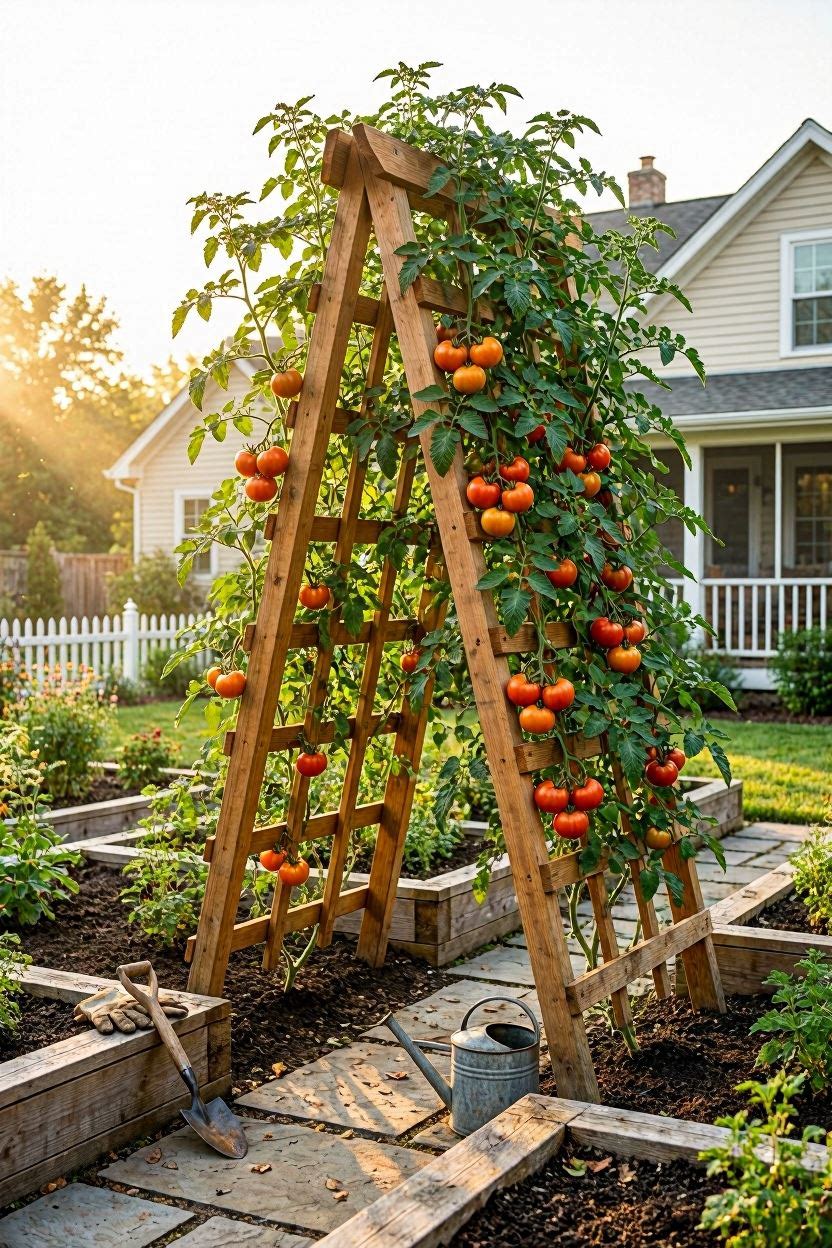
Introduction
Growing tomatoes is one of the most rewarding things you can do in your backyard — but without the right support, those vines flop over, fruit touches the ground, and you lose half your harvest.
A good tomato trellis fixes all of that. It keeps plants upright, improves airflow, and honestly makes your garden look a lot better too.
In this post, you’ll find 15 tomato trellis ideas for every skill level and budget — from a $5 bamboo stake setup to a beautiful cedar A-frame you can build in a weekend. Each idea includes what it costs, where to buy the materials in the USA, and exactly how to set it up.
Section 1: Why Your Tomatoes Need a Trellis
Before we get into the ideas, here’s a quick look at why proper support matters so much.
| Problem Without a Trellis | What a Trellis Does |
|---|---|
| Fruit rots on the ground | Keeps fruit clean and off the soil |
| Poor air circulation → disease | Opens up the canopy for airflow |
| Hard to water and prune | Makes every part of the plant accessible |
| Sprawling vines take over beds | Keeps plants tidy and contained |
| Lower yield | More sun exposure = more fruit |
Whether you’re growing in a raised bed, a pot, or a big backyard plot, supporting your tomato plants pays off every single time.
Section 2: Quick Overview — 15 Trellis Ideas at a Glance
| # | Trellis Type | Best For | Approx. Cost | Skill Level |
|---|---|---|---|---|
| 1 | Single bamboo stake | Patio pots | $2–$5 | Beginner |
| 2 | Florida Weave | Row gardens | $10–$20 | Beginner |
| 3 | Tomato cage (wire) | Raised beds | $8–$15 each | Beginner |
| 4 | T-post + wire fence | Large gardens | $30–$60 | Beginner |
| 5 | A-frame wooden trellis | Backyard beds | $40–$80 | Intermediate |
| 6 | Cattle panel arch | Big gardens | $50–$100 | Intermediate |
| 7 | PVC pipe trellis | Budget DIY | $15–$30 | Beginner |
| 8 | Wooden ladder trellis | Decorative gardens | $20–$50 | Beginner |
| 9 | String trellis system | Raised beds | $10–$25 | Beginner |
| 10 | Rebar + twine | Long rows | $15–$30 | Beginner |
| 11 | Pallet trellis | Upcycle project | $0–$10 | Beginner |
| 12 | Hog panel trellis | Heavy producers | $40–$70 | Intermediate |
| 13 | Bamboo teepee | Small spaces | $10–$20 | Beginner |
| 14 | Conduit pipe trellis | Permanent setup | $30–$60 | Intermediate |
| 15 | Trellis net on posts | High-yield rows | $20–$40 | Beginner |
Section 3: Best Tomato Trellis Ideas — Step by Step
3.1 The Florida Weave (Best for Row Gardens)
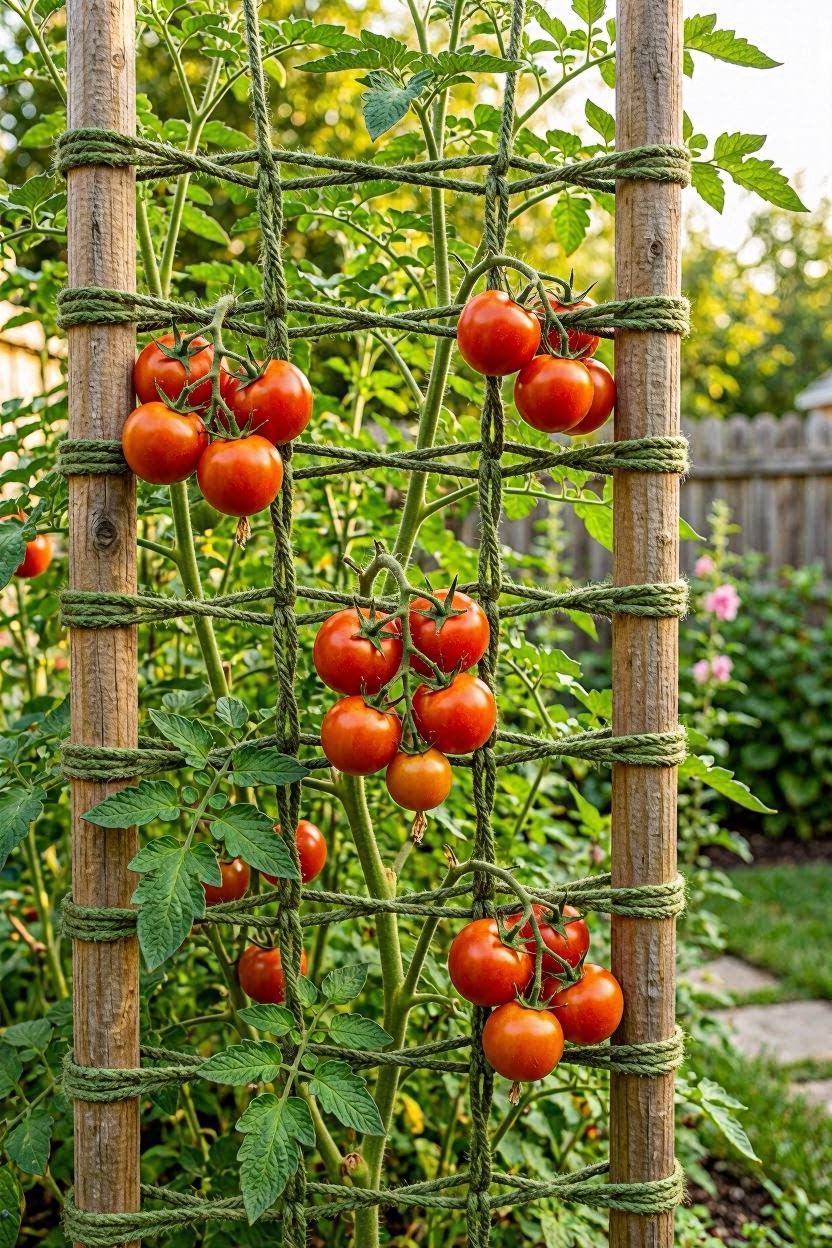
The Florida Weave is one of the most popular commercial tomato support methods — and it works just as well in home gardens. It uses stakes and twine woven back and forth between plants to hold them upright as they grow.
What you need:
- Wooden or metal stakes (5–6 ft tall) — available at Home Depot for about $1–$3 each
- Jute or polypropylene twine (Amazon, ~$8–$12 per roll)
How to set it up:
- Plant your tomatoes in a straight row, about 18–24 inches apart.
- Drive a stake between every two plants, pushing it at least 12 inches into the soil.
- Tie your twine to the first stake, about 10 inches off the ground.
- Weave it in front of one plant, behind the next, and so on down the row.
- Tie it off at the end stake, then come back up the other side.
- Add a new row of twine every 8–10 inches as the plants grow taller.
Pro tip: Use thick twine (at least 3-ply) so it doesn’t cut into the stems. Jute is affordable and biodegradable — Lowe’s carries it for around $6.
3.2 DIY A-Frame Wooden Trellis (Best Looking Option)
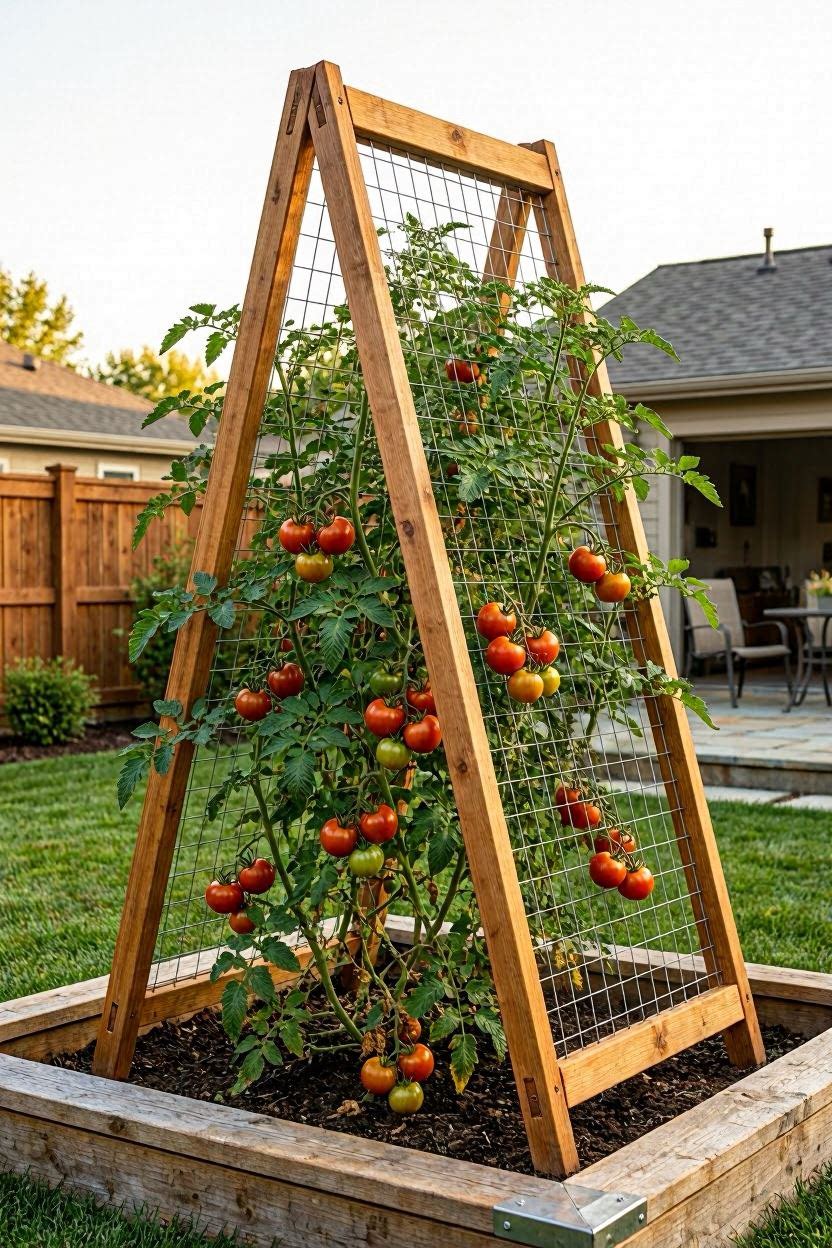
An A-frame trellis is sturdy, reusable, and looks great in any backyard. You can build one from cedar 2x4s in a couple of hours.
Materials (for one 4-ft wide A-frame):
- 4 cedar 2x4s, 6 ft long (~$5–$8 each at Lowe’s)
- 1 roll of 4-ft wide wire mesh or chicken wire (~$15–$20)
- Hinges (2) to connect the top (~$4 at Home Depot)
- Staple gun + staples
Build steps:
- Cut two pairs of 2x4s to 6 ft each — these are your side legs.
- Connect one pair at the top with a hinge to form a V shape. Repeat for the second pair.
- Connect the two V frames with 2x4 crossbars at the bottom for stability.
- Staple wire mesh across both slanted sides.
- Stand it up in your garden and let tomatoes grow up both sides.
Cost: Around $40–$60 total. A pre-built version (Gardener’s Supply Company) runs about $80–$120.
3.3 Cattle Panel Arch Trellis (Best for Large Gardens)
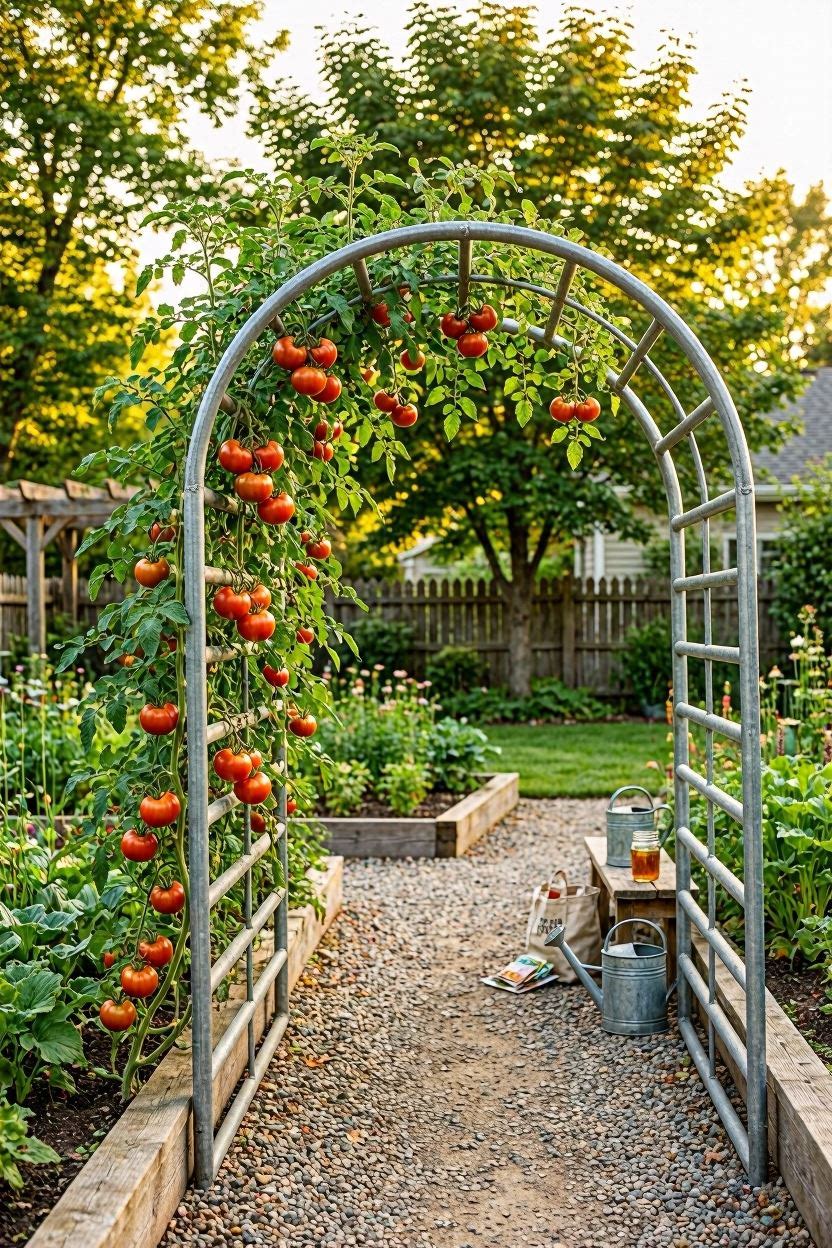
A cattle panel arch is one of the strongest and most satisfying trellises you can make. One 16-ft cattle panel bends naturally into an arch about 5 feet tall — tall enough to walk under and harvest from both sides.
What you need:
- 1 cattle panel, 16 ft × 50 inches (Tractor Supply Co., ~$25–$35)
- 4 metal T-posts (~$5–$8 each)
- Wire or zip ties to secure the panel to the posts
How to set it up:
- Pound two T-posts into the ground on each side of your bed, about 4 ft apart.
- Flex the cattle panel into an arch shape and hook or zip-tie each end to the T-posts.
- The arch holds itself in shape once secured.
- Plant tomatoes at the base of each side and train them upward.
Why it works: Cattle panels are galvanized steel — they last 20+ years. Heavy indeterminate tomatoes like Brandywine or Big Boy handle the support easily.
3.4 Bamboo Teepee Trellis (Best for Small Spaces)
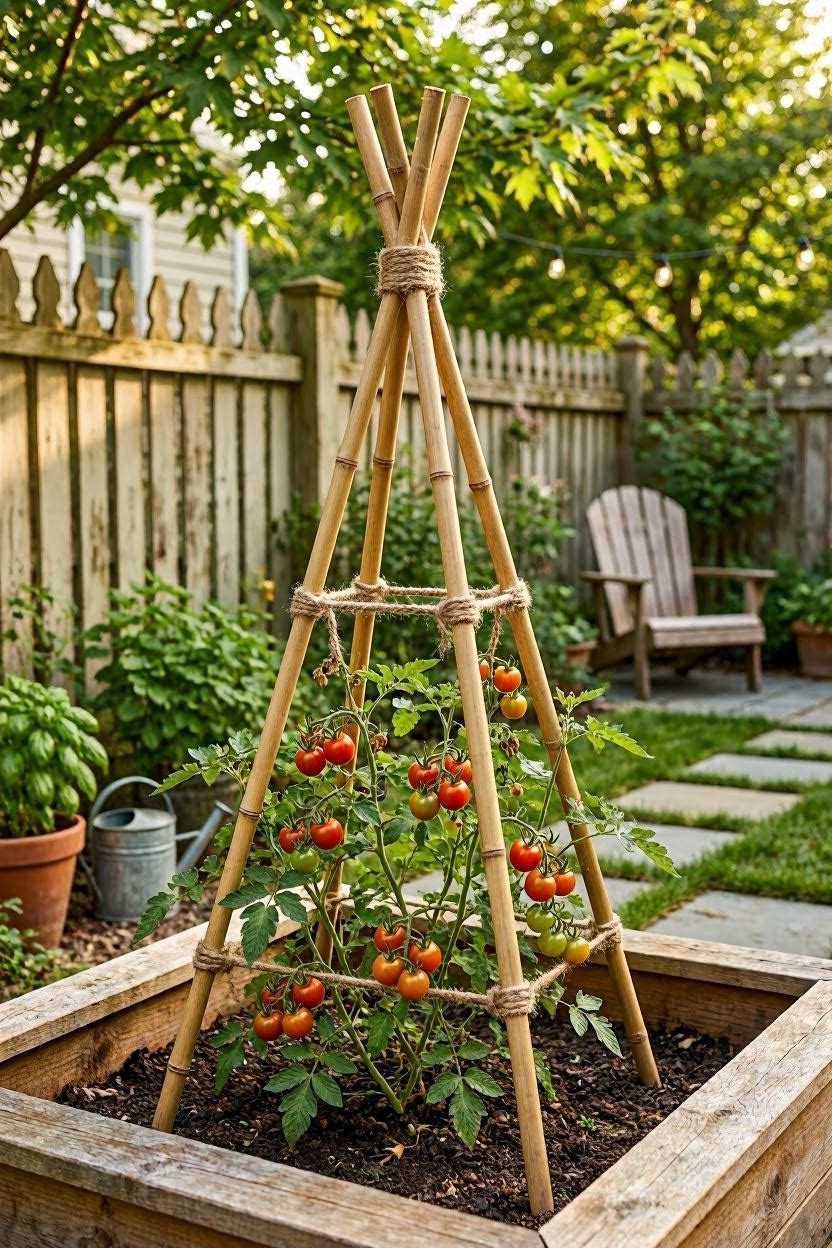
A bamboo teepee is cheap, easy, and looks charming in small garden beds or containers. It’s perfect for cherry tomatoes or compact varieties.
What you need:
- 4–6 bamboo poles, 6–7 ft tall (~$1–$3 each at garden centers or Amazon)
- Jute twine
How to set it up:
- Push 4–6 poles into the soil in a circle, each about 8 inches from the center.
- Lean the tops together and wrap tightly with jute twine.
- Wrap twine horizontally around the poles at 6-inch intervals going down — this gives the vines more to grab.
- Plant one tomato at the base of each pole.
Cost: Under $15 for a full teepee. Works beautifully in a 2-ft diameter pot too.
3.5 String Trellis System for Raised Beds
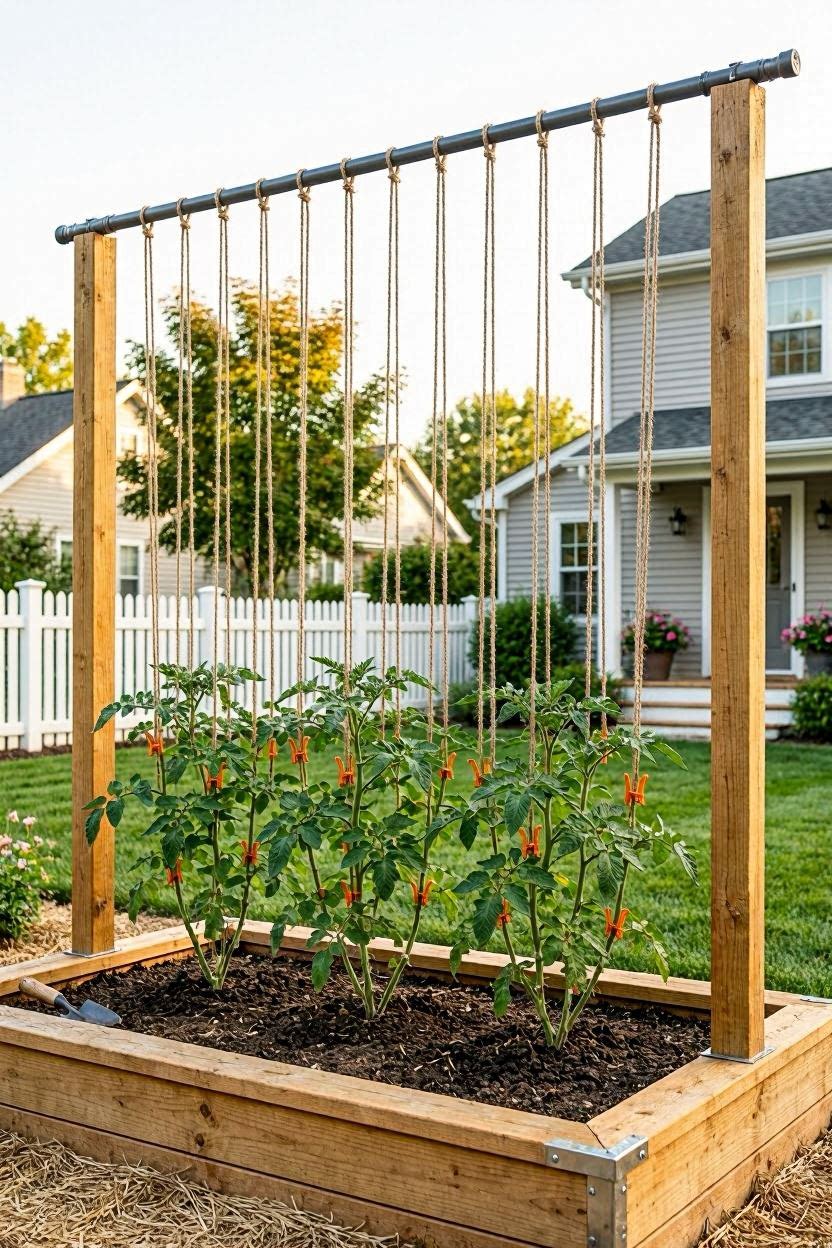
If you grow tomatoes in raised beds, a vertical string system is the cleanest and most space-efficient setup you can use. This is what most greenhouse growers use.
What you need:
- 2 wooden or metal posts, 7–8 ft tall (set outside the raised bed)
- 1 horizontal top rail or pipe (EMT conduit from Home Depot, ~$8)
- Tomato clips or twist ties (~$6–$10 for a bag of 100 on Amazon)
- Jute or cotton twine
How to set it up:
- Set posts at each end of your raised bed and run a horizontal bar across the top.
- Drop a length of twine from the top bar down to the base of each plant.
- Tie the bottom loosely around the base of the plant stem.
- As the plant grows, gently twist the stem around the string or use tomato clips.
- Keep training the stem upward every few days.
Why it’s great: You can lower and lean the plant sideways as it reaches the top — this is the “lower and lean” technique used by commercial growers. It doubles your yield in a small space.
3.6 Pallet Trellis (Best Upcycled Option)
Old wooden pallets make surprisingly good tomato trellises. The slats are perfectly spaced for weaving twine, and the whole thing costs almost nothing.
What you need:
- 1–2 heat-treated (HT-stamped) wooden pallets — free from garden centers or hardware stores
- 2 stakes or T-posts to anchor them upright
- Twine or zip ties
How to set it up:
- Find HT-stamped pallets (avoid MB-stamped — those are treated with chemicals).
- Stand the pallet upright behind your tomato plants and anchor it to T-posts so it doesn’t tip.
- Weave twine through the slats horizontally for extra support as the plants grow.
- Tie stems loosely to the pallet slats.
Cost: Essentially free. A single pallet supports 2–3 tomato plants easily.
3.7 T-Post and Wire Fence Trellis (Best for Long Rows)
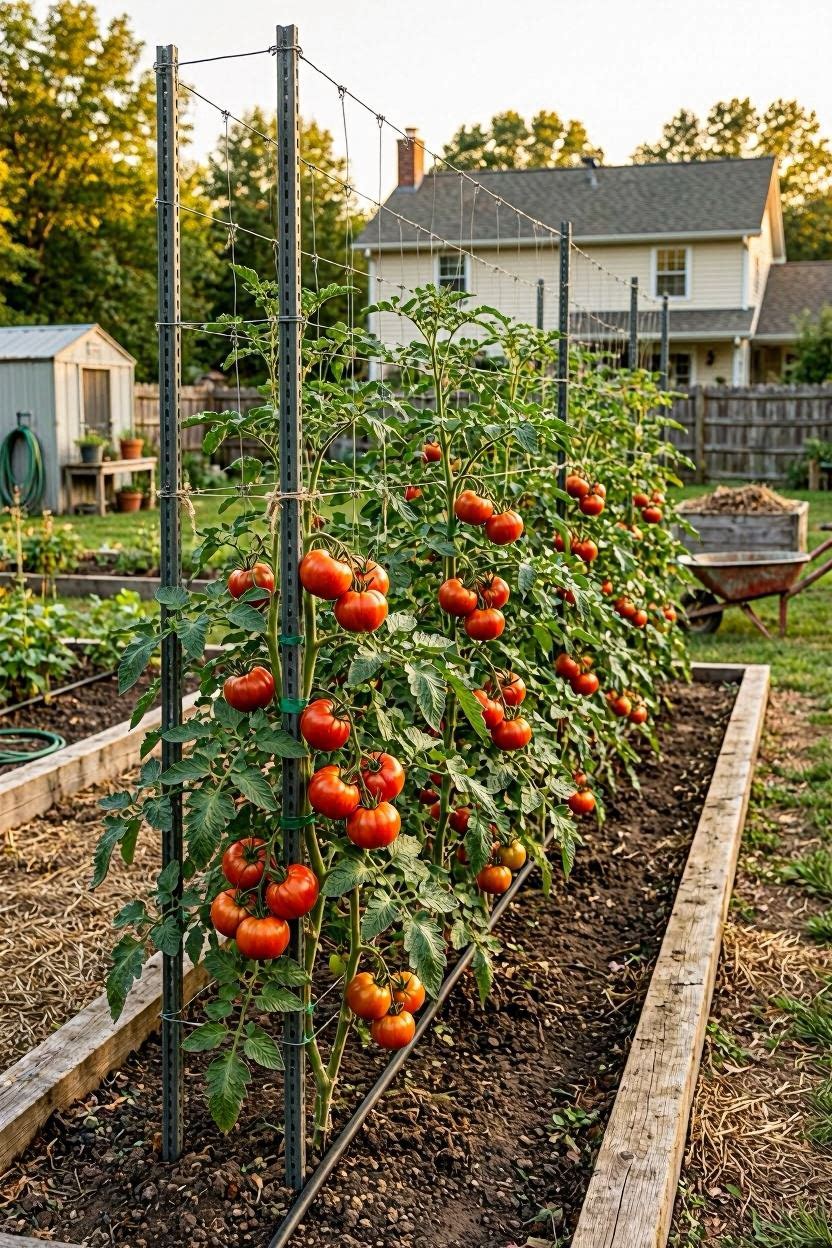
For anyone growing more than 6–8 tomato plants in a row, a T-post and wire fence is the most heavy-duty and reliable option.
What you need:
- Metal T-posts, 6 ft (Tractor Supply Co. or Home Depot, ~$5–$8 each)
- A T-post driver (~$15–$25 rental or purchase)
- 14-gauge wire or livestock fence panel
- Wire clips or zip ties
How to set it up:
- Drive T-posts every 4–5 feet along your tomato row, at least 18 inches into the ground.
- Attach wire fencing or stretch multiple horizontal wires between the posts at 12, 24, and 36 inches off the ground.
- Clip or tie tomato stems to the wire as they grow.
Cost: $30–$60 for a 20-foot row. This setup will last a decade or more.
Section 4: Choosing the Right Trellis for Your Setup
4.1 By Tomato Type
| Tomato Type | Examples | Best Trellis |
|---|---|---|
| Indeterminate (tall, keep growing) | Brandywine, Cherokee Purple, Sun Gold | A-frame, cattle panel, T-post fence |
| Determinate (compact, fixed height) | Roma, Celebrity, Patio | Bamboo stake, small cage, teepee |
| Cherry/grape tomatoes | Sweet 100, Juliet | String trellis, bamboo teepee |
| Container tomatoes | Tumbling Tom, Bush Early Girl | Single stake, small cage |
4.2 By Garden Type
| Garden Setup | Best Trellis Choice |
|---|---|
| Raised bed (4×4 or 4×8) | String trellis, A-frame, wire cage |
| In-ground row garden | Florida weave, T-post fence, cattle panel |
| Container / patio | Bamboo stake, small teepee, single cage |
| Small urban garden | Wooden ladder, pallet trellis, net trellis |
| Large homestead | Cattle panel arch, hog panel, T-post fence |
Section 5: Materials Guide — What to Buy and Where
| Material | Best Use | Where to Buy | Price Range |
|---|---|---|---|
| Bamboo stakes (6 ft) | Stakes, teepees | Amazon, Walmart, garden centers | $1–$3 each |
| Cedar 2x4s | DIY frames | Home Depot, Lowe’s | $5–$10 each |
| Cattle panels | Arches, flat trellises | Tractor Supply Co. | $25–$40 each |
| T-posts (6 ft) | Row fencing | Tractor Supply, Home Depot | $5–$8 each |
| Jute twine | Florida weave, tying | Amazon, Lowe’s, ACE Hardware | $5–$12/roll |
| Wire tomato cages | Single plants | Walmart, Home Depot, Amazon | $8–$15 each |
| EMT conduit (10 ft) | Frame top bars | Home Depot | $6–$10 |
| Tomato clips (100 pk) | String systems | Amazon | $6–$10 |
| Hog panels | Heavy support | Tractor Supply Co. | $30–$50 |
| Trellis netting | Net systems | Amazon, garden centers | $10–$20/roll |
Section 6: Pro Tips for Any Trellis System
1. Install before you plant. It’s much easier to set up your trellis when the bed is empty. Doing it after can damage roots.
2. Go taller than you think you need. Indeterminate tomatoes can reach 6–8 feet. A 4-foot cage is rarely enough.
3. Tie loosely. Stems swell as plants grow. A tight tie becomes a tourniquet. Use figure-8 ties or silicone tomato clips instead of wrapping directly.
4. Prune suckers. If you’re using a string or A-frame system, removing suckers keeps the plant to one or two main stems — much easier to manage and train.
5. Anchor everything deeply. A loaded tomato plant is surprisingly heavy. T-posts should go 18 inches into the ground minimum. Bamboo stakes need at least 12 inches.
6. Label each plant. If you’re growing multiple varieties, tag them at planting time. It’s easy to forget which is which by midsummer.
Section 7: Frequently Asked Questions
Q: When should I put up a tomato trellis? Set up your trellis before or right when you transplant seedlings. Doing it later risks disturbing roots and you’ll already be playing catch-up.
Q: Can I use a trellis for tomatoes in containers? Yes — a single bamboo stake or a small wire cage works perfectly in a 5-gallon or larger pot. Make sure the container is heavy enough to not tip over as the plant grows.
Q: What’s the difference between determinate and indeterminate tomatoes? Determinate tomatoes grow to a fixed height (usually 3–4 ft) and ripen all at once. Indeterminate tomatoes keep growing and fruiting all season and can reach 8 ft or more — they need much taller, sturdier support.
Q: How often do I need to tie up my tomatoes? During peak growing season, check and train your plants every 3–5 days. They grow fast and can quickly outpace your trellis if you’re not watching.
Q: Are metal cages better than wood trellises? Both work well. Metal cages are quicker and cheaper per plant. Wood or custom trellises look better, last longer when well-built, and handle heavier producers better.
Final Thoughts
A good tomato trellis doesn’t have to be expensive or complicated. Even a few bamboo stakes and a roll of jute twine will dramatically improve your harvest over no support at all.
If you’re just getting started, try the Florida Weave — it’s fast, cheap, and incredibly effective for row gardens. If you want something that looks great and lasts for years, the DIY A-frame or cattle panel arch is worth every dollar.
The most important thing is to get the support in place early and keep training your plants as they grow. Do that, and you’ll be hauling in tomatoes all summer long.
Happy growing!